


International Clinical Training Center for Ophthalmologists and Optometrists
Date & Time
Background
In India, there are 30,000 ophthalmologists serving the community. Every year, the state of Tamil Nadu in India produces about 200 ophthalmologists and 500 optometrists, including several from private institutions. Aravind Eye Care System (AECS / Aravind) has significant expertise in the domain of eye-care that it is willing to share with these ophthalmologists and optometrists. A comprehensive training center will help in this objective of further training and better equipping the state's aspiring ophthalmologists and optometrists.
The basic objective of this grant project is to help Aravind set up a cutting-edge training facility at their Chennai hospital (Aravind-Chennai) that will help supplement the education and practice of ophthalmologists and optometrists in the state of Tamil Nadu, India. The long-term goal is to benefit ophthalmologists and optometrists all over India and in other countries too.
About the Project, its aim and purpose:
Projects Aim and Purpose
Aravind-Chennai is proposing to establish an Ophthal Learning Hub for ophthalmologists and optometrists for postgraduate training and fellowship programs. The project seeks to set up a state-of-the-art…
Background
In India, there are 30,000 ophthalmologists serving the community. Every year, the state of Tamil Nadu in India produces about 200 ophthalmologists and 500 optometrists, including several from private institutions. Aravind Eye Care System (AECS / Aravind) has significant expertise in the domain of eye-care that it is willing to share with these ophthalmologists and optometrists. A comprehensive training center will help in this objective of further training and better equipping the state's aspiring ophthalmologists and optometrists.
The basic objective of this grant project is to help Aravind set up a cutting-edge training facility at their Chennai hospital (Aravind-Chennai) that will help supplement the education and practice of ophthalmologists and optometrists in the state of Tamil Nadu, India. The long-term goal is to benefit ophthalmologists and optometrists all over India and in other countries too.
About the Project, its aim and purpose:
Projects Aim and Purpose
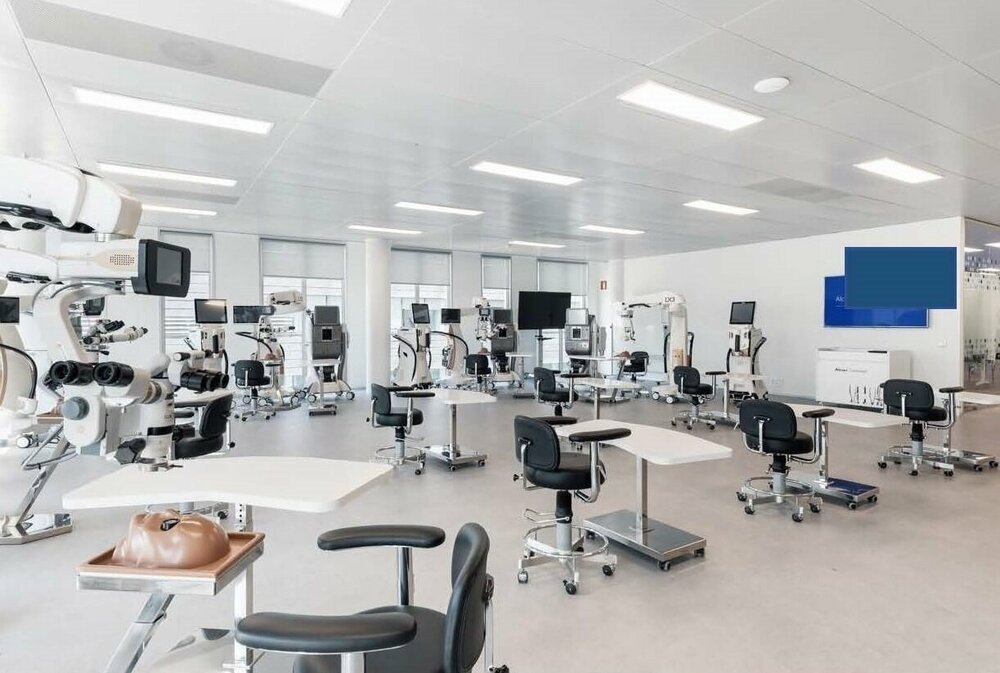
Aravind-Chennai is proposing to establish an Ophthal Learning Hub for ophthalmologists and optometrists for postgraduate training and fellowship programs. The project seeks to set up a state-of-the-art learning hub for ophthalmic surgeons and optometrists with advanced technology and the latest equipment. This center will facilitate hybrid ways of skill enhancement – providing a range of courses across skill sets, by combining virtual and hands-on sessions and observation. The facility will increase global connect by broadening the horizon of learning through classroom lectures, live streaming sessions like live OT feed, periodic live and recorded lectures, live wet lab streaming and will also have a comprehensive reference library.
Rotary Club of Irvine has formed a three-member committee to interact with RCME in project planning and execution, monitor stewardship and timely reporting and publicize project progress, achievement and experience in their club, district and other Rotary forum. RC Irvine has partnered with RCME on several Global Grant projects in the past. It has been a very proactive partner and Irvine club members have visited several of RCME’s projects in the past. A representative from RC Irvine will endeavor to visit this project too.
What is the impact of the project?
39 million people are blind in the world. Of these, 12 million live in India. Common causes of blindness in India are Cataract, Uncorrected refractive errors, Glaucoma, Diabetic Retinopathy, Corneal Opacity etc. 80% of all blindness is treatable. 200 million people need eye care in India, but less than 10% are covered through existing health care facilities and eye screening camps (Source: A VISION 2020: The Right to Sight INDIA -Dec 2011 Publication).
Due to an aging population in the country, the need for eyecare in India is expected to increase three times over the next decade. On the one hand, there is therefore a need for quality eye care.
Over the last 5 years, while the Government has doubled MBBS (Bachelor of Medicine and Bachelor of Surgery) and Post Graduate seats, infra development in private institutions has not kept pace.
In most medical colleges, ophthalmology is not the predominant specialty and the number of outpatients in the ophthalmology department would be around 50 per day. Aravind-Chennai, on the other hand, sees 1500 to 2000 outpatients a day. Hence, Aravind has the compulsion to invest in the latest Ophthalmic equipment which may not be practical to expect of other institutions.
Consequently, eyecare graduates from private institutions can benefit from the experience that Aravind has to offer in providing quality eyecare, the need for which will increase substantially over the next decade.
Therefore, Aravind perceived a real need for focused and relevant training.
How will the funds be used
The following equipment are proposed to be purchased under this Global Grant project:
i) Microscopes for wet lab
ii) Phaco machine
iii) Surgical Microscope
iv) Optical Coherence Tomography (OCT) machine
v) Slit lamp
vi) Biometry
Besides the above, there are other equipment such as audio-visual systems, computers etc., required for the training center. These will either be contributed by the industry partners, corporates or purchased by the beneficiary itself.
Initially, Aravind hopes to teach and train 100 ophthalmologists and 100 optometrists graduating in the state of Tamil Nadu (India) every year. Each of these 100 doctors, in turn, will carry out around 500 to 750 surgeries every year during their career. Hence, the number of indirect patient beneficiaries of better healthcare will be around 50,000 to 75,000 per annum to start with. This would only geometrically increase with every passing year.